From Matchmaker’s Ledger to the Dating Profile Card
Compare matchmaker ledgers with dating profile cards to see how each format frames a potential partner—and where its limits call for a different judgment.
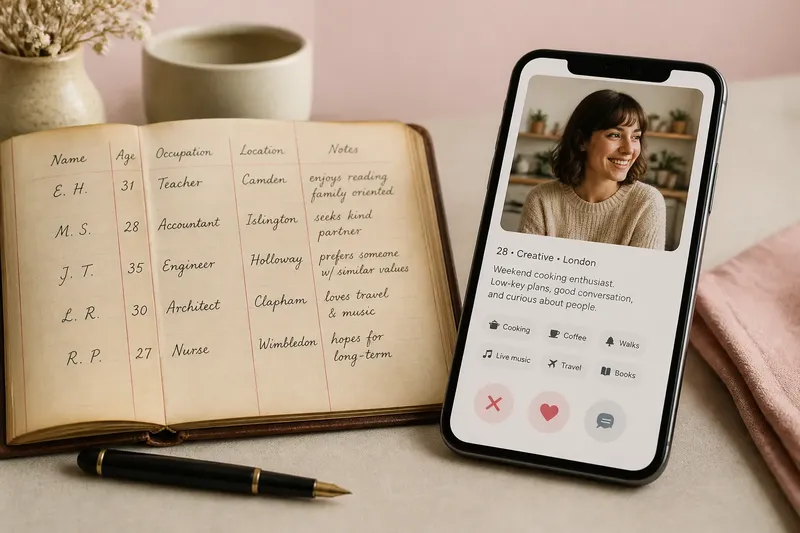
What does a dating profile card let you judge that a matchmaker’s ledger might not? The answer is less about which format reveals the “real” person and more about who chooses the details, how those details are arranged, and what kind of decision the reader is being asked to make.
Who chose what went into the record?
A ledger or personal record used by a matchmaker can be understood as an intermediary’s working document: a way to keep track of people and possible introductions. Depending on its maker and purpose, it might contain practical details such as a person’s occupation, neighborhood, family circumstances, or stated hopes. Those are illustrative possibilities, not a claim that matchmakers everywhere kept the same records.
A dating profile shifts more of the selection to the person being described. They choose a photograph, answer prompts, and decide how to present their interests or hopes to strangers. That authorship matters, but it does not make a profile a complete portrait; it is still a short, audience-facing account.
How does each format shape a first impression?
A record organized in fixed fields invites comparison. A reader may scan location, work, or preferences side by side, while an open profile may lead with an image, a joke, or a carefully chosen detail. In either case, the layout affects what is easiest to notice before the reader knows much about the person.
Fixed fields can make certain practical differences visible while leaving unlisted qualities in the background. Open-ended writing can convey voice, but it also favors people who are comfortable describing themselves briefly. Neither format is neutral: each makes some information easier to see and other information easier to overlook.
What can each format leave out?
A matchmaker’s record may reflect the intermediary’s categories rather than the person’s own words. A dating profile may leave out context because its writer has limited space or does not yet know what a reader needs to understand. Even a truthful detail can be incomplete: “likes quiet weekends” does not explain what quiet means to that person or how it fits into their life.
It is not worth trying to decode every phrase as a hidden test. That effort can turn ordinary choices of wording into imagined evidence. Instead, distinguish what the profile states from the meaning you are assigning to it.
How should you compare a dating profile card with a matchmaker’s ledger?
Use the contrast to notice how information is selected, not to rank one format as inherently more trustworthy. These questions can help clarify what a record can and cannot support:
Who selected the details in a matchmaker’s ledger?
The intermediary or record-maker may have selected and organized the details for a particular purpose, such as keeping track of possible introductions. Without knowing how the record was made, treat its categories as evidence of what that record-maker considered relevant, not as a complete account of the person.
Does a self-written profile show someone’s personality?
It shows how a person chose to present themselves in that setting, which can offer a glimpse of their voice or interests. It does not settle what they are like across situations or how they will behave in a relationship.
What does a profile card reveal about compatibility?
It can show stated preferences and possible points of shared interest, but it cannot establish how two people will handle differences in daily life. Treat apparent alignment as a reason to consider further interaction, not as a verdict about compatibility.
What should you do with a detail you cannot interpret?
If the detail matters to your decision, ask a respectful, open question when a conversation makes that natural. If it does not matter yet, leave it unresolved rather than treating your first guess as fact.
What does a profile detail actually support?
Separate three things: the words on the page, your interpretation of them, and what you can learn through interaction. A profile may say someone enjoys cooking; you might infer that cooking is central to their social life, but the statement alone does not support that conclusion.
- If a detail names a specific activity, such as cooking, then treat it as a possible shared topic; if you have no interest in it, look for another detail that genuinely draws you in.
- If a preference is broad, such as wanting a relaxed weekend, then leave room for different meanings; if the distinction matters, ask what a relaxed weekend looks like to them.
- If a profile lists a value without explaining it, then do not assume your definition matches theirs; if that value is central to your choice, ask what it means in practice.
- If a photograph or opening line catches your attention, then notice that response without treating it as evidence of character; if other information matters more, read the rest before deciding whether to engage.
- If two profiles seem similar on paper, then regard the overlap as a starting point rather than proof of fit; if their stated priorities conflict with yours, weigh that conflict rather than the shared details alone.
- If a record gives practical information but no personal context, then use it only for the decision it supports; if you need to know how someone thinks or communicates, seek that information through an appropriate exchange.
Say you read a profile that lists weekend cooking and a preference for low-key social plans. You note the stated interests, but you do not assume they mean the person wants to spend every weekend at home. You send a message asking what they like to cook and what a low-key weekend usually means to them; if their answer is specific and leaves room for your own preferences, you have useful context for deciding whether to continue the exchange, while a mismatch in preferred social pace gives you a reason to pause.
Why is the format not a compatibility verdict?
A matchmaker’s ledger and a dating profile card are both selective ways to introduce someone, but they select from different positions. One may reflect an intermediary’s categories; the other reflects a person’s own presentation. Neither can carry all the context needed to judge how two people will relate.
The useful question is not whether the card captures a whole person. It is whether the information it offers is relevant enough to shape your next decision—and what remains unknown. Read the dating profile card as a deliberately limited introduction, then let the importance of the missing context determine whether to ask, wait, or move on.