What Compatibility Can Tell You Before You Know Someone
Compatibility before you know someone can point to useful questions about pace, priorities, and expectations without pretending to predict the relationship.

Compatibility before you know someone can make a profile feel more legible, but it cannot tell you what being together will feel like. Say you read that a potential date values quiet weekends and prefers direct communication. Those details offer a place to begin; they do not tell you whether the two of you will listen well, enjoy each other, or handle a disagreement with care.
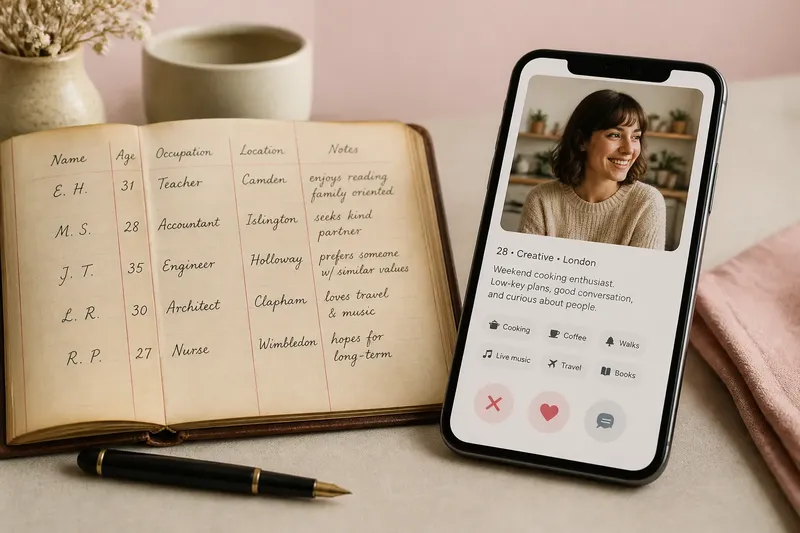
Imagine Maya, an invented person considering whether to meet Jordan, whose profile says he likes routine, wants a long-term relationship, and prefers to talk through problems promptly. Maya also wants a committed relationship, but she needs time to think before discussing a tense moment. She sees both a possible fit and a possible snag. The useful question is not whether the profile has delivered a verdict. It is what Maya can reasonably ask before treating a few points of comparison as a prediction.
What does a point of comparison actually tell you?
A point of comparison identifies something both people have said matters to them. It may concern relationship intent, preferred pace, communication habits, or the shape of an ordinary week. That information can help a person decide what to ask about and whether a first meeting seems worthwhile.
It says much less about how either person behaves in context. “I value direct communication” could mean someone speaks plainly and makes room for a response; it could also mean they expect immediate answers. The phrase alone does not distinguish between those possibilities, and a profile rarely has room to supply all the circumstances behind it.
In Maya’s case, the shared wish for a committed relationship is a meaningful point of comparison. It suggests that their broad intentions may align. It does not establish that they mean the same thing by commitment, want it on a similar timetable, or would make compatible choices as a couple.
Where does comparison turn into prediction?
Prediction begins when a stated preference gets treated as evidence of an unstated outcome. Maya might think, “We both want commitment, so we will probably want the same kind of relationship,” or, “He likes routine, so he will be a dependable partner.” Neither conclusion follows from the information she has.
The distinction matters because matching language often compresses complicated experiences into short labels. A shared answer can make a question easier to pose, but it cannot show how each person interprets the answer, changes their mind, or responds when plans become inconvenient. Those details emerge through conversation and, if both choose to continue, through repeated interactions.
A useful comparison should therefore remain modest. Maya can notice that Jordan’s preference for routine may affect how he likes to plan time together. She cannot infer from that preference whether he is flexible, controlling, steady, or considerate. Those are broader judgments that require evidence about his conduct, not an interpretation of a single label.
How can Maya use the profile without overreading it?
Maya can turn each point of comparison into an open question about meaning and practice. Rather than ask Jordan to defend his profile, she can invite him to describe what the preference looks like in an ordinary situation. The aim is not to interrogate him or to conduct a compatibility audit; it is to learn enough to decide whether they want another conversation.
She might ask, “When you say you like routine, what does a good weekend usually look like?” If he describes planning a meal and leaving room for an unexpected invitation, Maya learns something more specific than the label supplied. If he says he dislikes changing any plan, she learns something different—and can consider whether that pattern suits her.
For communication, Maya could say that she often needs a little time to collect her thoughts during a difficult conversation, then ask what “talking it through promptly” means to Jordan. A thoughtful exchange might reveal that he wants reassurance that the issue will be revisited, not an instant resolution. That does not settle whether their habits will fit, but it gives them a clearer subject to discuss.
In this imagined situation, Maya and Jordan discover that each values a planned week, while Jordan is comfortable postponing a difficult conversation if they agree on when to return to it. Maya decides to meet him because the difference seems discussable and neither has to pretend to be someone else. The expected observable result is modest: at a first meeting, she can see whether they explain their preferences clearly and show curiosity about each other. The meeting cannot confirm a lasting fit.
What questions help separate a clue from a forecast?
Does a shared relationship goal mean we want the same thing?
It gives you a useful topic, not a shared definition. Ask what each person hopes commitment will involve, and listen for concrete expectations as well as broad language.
Can a profile show how someone handles conflict?
It can point to a stated preference, such as speaking promptly or taking time to reflect. How the person listens, repairs a misunderstanding, and respects a pause is better judged through actual interactions.
Should a difference in communication style rule out a match?
Not by itself. A difference may be workable if both people can explain what they need and agree on a respectful way to handle tense moments; repeated dismissal or pressure would be more telling than the difference alone.
When is a match worth exploring?
When the information gives you a reason to be curious and no stated preference already conflicts with a boundary or essential expectation of yours. Meeting is an option, not an obligation or a promise of future compatibility.
What can only become clear through interaction?
Some qualities are not neatly available for comparison before people meet. Whether conversation feels reciprocal, whether humor lands kindly, whether silence feels comfortable, and whether each person follows through are observable in interaction. Even then, one pleasant exchange is a small piece of information rather than a final assessment.
Expectations also become clearer as two people respond to real choices. A profile may say that someone wants an equal partnership; deciding how to spend a holiday, divide a shared task, or make room for separate interests can reveal how that aspiration translates into behavior. There is no need to force those larger questions into a first date, but they should not be considered answered by a match score or shared phrase.
For Maya, the first meeting is not a trial in which Jordan must confirm every favorable interpretation. She can notice whether he asks questions, answers with care, and treats her need for a pause as information rather than a defect. She can also notice her own response: whether she feels free to be candid, not merely pleased that their profiles align.
What is not worth the effort?
It is not useful to build a complete imagined relationship from a handful of profile details, or to search for a perfect phrase that proves two people will never misunderstand each other. That work creates confidence without adding much knowledge. Nor does a minor difference need elaborate decoding before either person has expressed a concern.
A more grounded approach is to keep the claim proportionate to the evidence: this is a point worth asking about; this is a stated expectation that seems aligned; this is a difference I want to understand. Compatibility before you know someone is most useful when it helps you choose a thoughtful next question, while leaving room for the answer—and the person—to surprise you.